
Concern · Assessed at consultation
Acne Scarring & Post-Acne Marks Treatment in Birmingham
Acne can leave behind visible scarring, uneven texture, dark marks and areas of discolouration long after active breakouts have settled. At Hello Skin Clinic Birmingham, we take a consultation-first approach to assess your skin, understand the type of scarring or marks present and discuss suitable treatment options for your individual concerns.
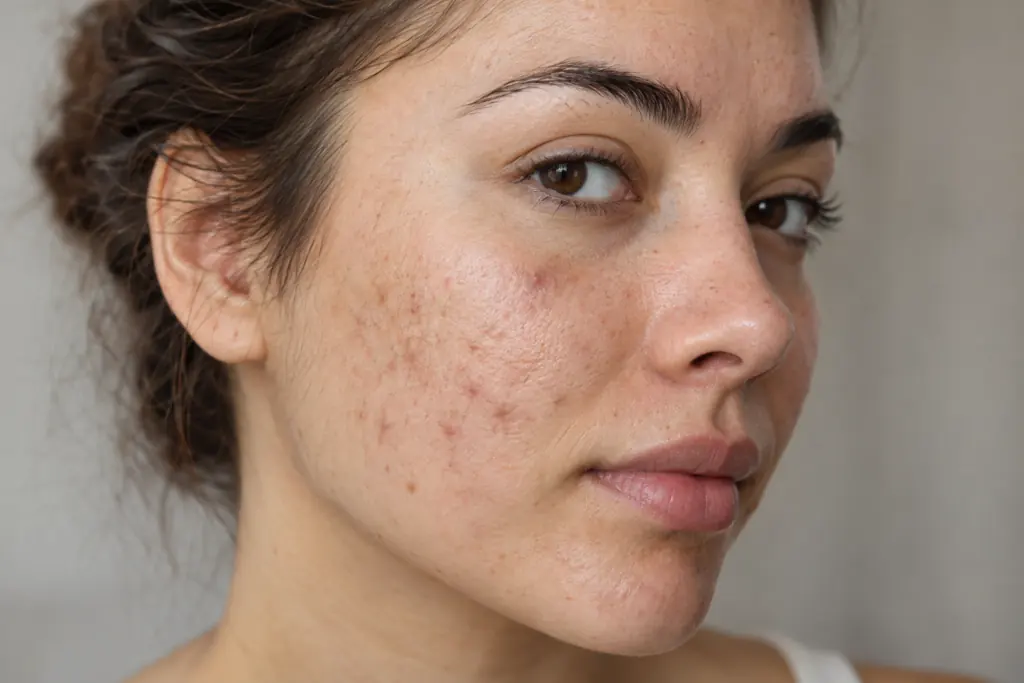
Understanding Acne Scarring & Post-Acne Marks
Acne scarring and post-acne marks can develop after inflammatory or recurring breakouts and may remain visible even when active acne has improved.
Some people experience changes in skin texture or shallow indentations, while others may notice lingering red, brown or darker marks where previous blemishes were present.
Different types of acne scarring and post-breakout pigmentation may require different approaches, which is why we begin by assessing your skin before recommending a treatment plan.
Common concerns may include:
- Indented or uneven acne scars
- Rough or irregular skin texture
- Post-acne dark marks
- Post-breakout redness
- Areas of pigmentation after acne
- Enlarged-looking pores
- Uneven skin tone
- Scarring on the cheeks, temples, jawline or forehead
Why Can Acne Leave Scars & Marks?
Acne can affect the skin in different ways, and not every blemish will leave the same type of mark or scar.
Factors may include:
Inflammation
Deeper or more inflamed breakouts can affect surrounding skin tissue and may increase the likelihood of visible scarring.
Changes in Collagen
During the healing process, changes in collagen production can contribute to indentations, uneven texture or raised areas.
Post-Inflammatory Pigmentation
After a breakout settles, excess pigment may remain in the area and appear as brown, darker or uneven patches.
Post-Breakout Redness
Some blemishes may leave lingering areas of redness even after the active breakout has resolved.
Picking or Squeezing
Repeatedly picking or squeezing blemishes can increase inflammation and may contribute to longer-lasting marks or textural changes.
Individual Skin Characteristics
Skin type, tone, healing response and the severity of previous acne can all influence how scars and marks appear.
Acne Scar Treatment Options at Hello Skin Clinic
Every person's skin and scarring pattern is different. Following consultation, we may discuss treatments designed to support skin renewal, improve the appearance of uneven texture and address post-acne marks where appropriate.
SQT Bio-Microneedling
SQT Bio-Microneedling may be considered for suitable clients looking to improve the appearance of uneven texture, post-acne marks and selected types of acne scarring through a skin-renewal approach.
Microneedling
Microneedling creates controlled micro-injuries within the skin to support natural collagen and skin-remodelling processes, helping improve the appearance of certain textural acne scars and uneven skin.
Chemical Peels
Professional chemical peels may help support skin renewal and improve the appearance of post-acne pigmentation, uneven tone, congestion and superficial textural concerns where suitable.
DMK Skin Treatments
A personalised DMK skin programme may be recommended to support overall skin function, texture, congestion and post-breakout concerns depending on your individual assessment.
Your Acne Scarring Consultation in Birmingham
We don't expect you to know what type of acne scar or post-acne mark you have before visiting us.
During your consultation, we will discuss:
- Your main skin concerns
- Your history of acne and breakouts
- Whether active acne is still present
- The areas affected by scarring or pigmentation
- Your current skincare routine
- Previous treatments
- Skin sensitivity and suitability
- Your goals and expectations
- Suitable professional treatment options
- Recommended homecare where appropriate
From there, we can discuss a personalised treatment pathway based on the type and appearance of your scarring rather than using the same treatment for every client.
Consultation First. Treatment Second.
At Hello Skin Clinic, acne scarring is not treated as one single concern.
Indented scars, uneven texture, pigmentation and post-breakout redness can behave differently and may require different treatment approaches.
We first assess your skin, understand what you would like to improve and determine which of the treatments available at the clinic may be suitable for you.
If active acne is still present, we may recommend addressing ongoing breakouts before or alongside certain scar-focused treatments.
Where your skin concern requires medical assessment or falls outside the scope of aesthetic skin treatments, we may recommend seeking advice from an appropriate healthcare professional.
What Happens at Your Skin Appointment
Step 1 / 4
Consultation
Tell us about your acne history, scarring, post-breakout marks and what you would most like to improve.
Further reading
Treatment options explained
Search online and you will find microneedling, chemical peels, SQT Bio-Microneedling, laser treatments, PRP, subcision and many other options — often all being promoted as the “best” acne scar treatment.
The reality is more complicated.
Different acne scars need different treatments.
An ice-pick scar is structurally different from a rolling scar. A raised scar needs a very different approach from a depressed scar. And the brown or red marks that remain after acne are not always true scars at all.
At Hello Skin Clinic Birmingham, we believe the first step should be identifying what you actually have before choosing a treatment.
This guide explains the main types of acne scarring, which treatments may be considered for each type, where treatments such as microneedling, SQT and chemical peels fit into the picture, and when a more specialist procedure may be appropriate.
Concerned about acne scars in Birmingham?
Start with a skin consultation at Hello Skin Clinic so your scarring, post-acne marks and current skin condition can be assessed before a treatment plan is recommended.
What Are Acne Scars?
Acne scars develop when inflammation associated with acne damages the skin and the normal healing process changes the structure of the tissue.
Some scars form because insufficient collagen is produced during healing, leaving an indentation.
Others form because too much scar tissue develops, creating a raised scar.
The NHS broadly categorises scars into types including atrophic scars, which appear sunken or pitted, and raised hypertrophic or keloid scars.
For acne specifically, depressed or atrophic acne scars are commonly divided into three main types:
- ice-pick scars
- boxcar scars
- rolling scars
These differences matter because there is no single procedure that is automatically best for every acne scar.
Acne Scars vs Acne Marks: They Are Not the Same
This is one of the most important things to understand before booking treatment.
Many people say they have acne scars when they actually have post-acne marks.
After a breakout disappears, you may be left with:
Brown or darker marks
These may represent post-inflammatory hyperpigmentation, where excess pigment remains after inflammation.
Red or pink marks
These can be related to persistent post-inflammatory redness or vascular changes.
Indented areas
These are more likely to represent true atrophic acne scars, where the structure of the skin has changed.
Raised scars
Some people develop hypertrophic or keloid-type scars.
The treatment for pigmentation is not necessarily the treatment for structural scarring.
That is why simply searching:
“What is the best acne scar treatment?”
can produce the wrong answer.
The better question is:
“What type of acne scarring or post-acne mark do I actually have?”
Ice-Pick Scars
Ice-pick scars are narrow, deep depressions that can look as though the skin has been punctured by a sharp object.
They usually have a small opening at the surface but extend deeper into the skin.
Because of their depth, superficial treatments alone may not always produce the desired improvement.
Specialist procedures may sometimes be required depending on the severity.
Boxcar Scars
Boxcar scars are broader depressions with relatively defined edges.
They may be shallow or deeper and often resemble small craters or indentations.
Shallower boxcar scars may respond differently from deep boxcar scars, so scar depth is important when selecting treatment.
Rolling Scars
Rolling scars often create a wavy or uneven appearance across the skin.
They can occur where scar tissue beneath the surface pulls the skin downward.
Because some rolling scars are tethered underneath the skin, treatments that only work on the surface may not fully address the underlying structure.
In selected cases, procedures such as subcision may need to be discussed with an appropriately qualified medical practitioner.
Raised Acne Scars
Raised acne scars develop differently from depressed scars.
Hypertrophic scars remain raised but generally stay within the original affected area, while keloids can extend beyond it.
These scars often require specialist medical treatment and should not simply be treated with standard resurfacing procedures designed for depressed scars.
The American Academy of Dermatology notes that raised scars may require options such as corticosteroid injections, laser treatment or other medical approaches.
Which Acne Scar Treatment Is Best?
There is no universal winner.
The most appropriate treatment depends on:
- scar type
- scar depth
- number of scars
- skin tone
- active acne
- pigmentation
- sensitivity
- previous treatments
- expected downtime
- treatment goals
- budget
It is also common for one person to have more than one type of scar at the same time.
For example, someone may have rolling scars across the cheeks, several boxcar scars and post-inflammatory pigmentation.
That is why combination treatment is frequently considered for acne scarring rather than relying on one procedure alone. Dermatology guidance also notes that treatment plans often combine approaches according to scar type and individual needs.
Acne Scar Treatments at a Glance
This is a guide only.
The treatment should follow the diagnosis of the scar — not the other way around.
Microneedling for Acne Scars
Microneedling is one of the most established non-surgical treatments used for certain types of atrophic acne scarring.
A professional microneedling device uses very fine needles to create controlled micro-injuries within the skin.
The healing response stimulates processes involving collagen and elastin, which can gradually improve the appearance of some depressed scars and uneven texture.
The American Academy of Dermatology specifically includes microneedling among treatments used for depressed acne scars and notes that it can be used across different skin tones.
Microneedling may be particularly relevant where the concerns include:
- shallow depressed scars
- uneven texture
- enlarged-looking pores
- overall textural irregularity
But it is not automatically suitable for every scar.
A very deep ice-pick scar, for example, presents a different structural problem from mild rolling texture.
How Many Microneedling Sessions Are Needed for Acne Scars?
Acne scarring is usually not treated as a one-session problem.
A course may be recommended depending on:
- severity
- scar type
- depth
- skin response
- treatment intensity
- overall plan
Collagen remodelling also takes time.
This means results should be assessed over months rather than expecting a final result a few days after treatment.
A 2026 systematic review comparing microneedling with chemical peels for atrophic acne scars found both approaches can improve scars, without clear evidence that one is universally superior. Treatment therefore needs to be individualised.
What Is SQT Bio-Microneedling?
SQT Bio-Microneedling works differently from traditional microneedling.
Rather than using a motorised pen containing metal needles, SQT uses microscopic biological spicules that are manually worked into the skin.
At Hello Skin Clinic Birmingham, SQT may be considered for suitable concerns including:
- post-breakout marks
- uneven texture
- visible pores
- congestion
- pigmentation
- overall skin renewal
It can therefore be relevant for someone whose “acne scarring” is actually a mixture of texture, pigmentation and post-breakout marks.
However, this distinction matters:
SQT should not automatically be presented as the solution to every deep structural acne scar.
A deep tethered rolling scar or severe ice-pick scar is a different problem from superficial post-acne texture.
That is why skin assessment comes first.
SQT vs Microneedling for Acne Scars
These treatments should not be treated as interchangeable.
Traditional Microneedling
Uses fine needles at controlled depths to create mechanical microchannels and stimulate a wound-healing response.
It may be particularly relevant for selected atrophic and textural scars.
SQT Bio-Microneedling
Uses microscopic biological spicules and can be used within a broader skin-renewal strategy addressing concerns such as:
- congestion
- post-breakout pigmentation
- visible pores
- uneven texture
- dullness
Which should you choose?
That depends on what your skin actually shows.
If you mainly have structural depressed scars, traditional microneedling or another scar-specific procedure may be more relevant.
If you have congestion, superficial marks, pigmentation and texture together, SQT may be worth considering.
Some clients may need a completely different approach.
Chemical Peels for Acne Scars and Post-Acne Marks
Chemical peels use controlled chemical exfoliation to create changes at selected depths within the skin.
Different peeling agents and strengths have very different effects.
Professional peels may be considered for:
- post-inflammatory pigmentation
- uneven tone
- acne-prone congestion
- superficial texture
- selected shallow atrophic scars
However, a mild superficial peel cannot simply erase a deep structural scar.
The stronger the treatment, the more important professional assessment and risk management become.
Research comparing chemical peels and microneedling suggests both can improve selected atrophic acne scars, with no consistent evidence that one method is best for every patient.
Chemical Peel vs Microneedling for Acne Scars
A simple way to think about the difference is:
Chemical Peel
Primarily uses controlled chemical resurfacing.
Potentially useful where pigmentation, congestion and superficial irregularity are significant components of the problem.
Microneedling
Creates controlled mechanical micro-injury.
Often considered where improving depressed texture and stimulating dermal remodelling is a major objective.
Neither treatment should automatically be declared “better.”
In fact, systematic-review evidence suggests combination approaches involving microneedling and chemical peeling may have value in selected atrophic scars, although treatment protocols still vary.
Can PRP Help Acne Scars?
PRP — platelet-rich plasma — may sometimes be used alongside procedures such as microneedling.
PRP is prepared from the patient's own blood and contains platelets involved in wound-healing processes.
The American Academy of Dermatology notes that PRP can be used to enhance another treatment such as microneedling for depressed scars.
This does not mean PRP alone is automatically the best acne-scar treatment.
It is more commonly considered as part of a broader treatment strategy.
What About Laser Treatment for Acne Scars?
Laser resurfacing can be an effective option for certain acne scars.
Different laser systems work at different depths and involve different levels of downtime and risk.
Some technologies remove microscopic columns or layers of tissue, while non-ablative approaches stimulate deeper remodelling with less surface injury.
Evidence reviews identify fractional and other laser treatments among established options for atrophic acne scars.
However, laser is not automatically suitable for every patient.
Skin tone, pigmentation risk, scar type and downtime all need to be considered.
If your scarring is severe or requires technology not offered by Hello Skin Clinic, an appropriate dermatology or medical referral may be the better recommendation.
Some rolling acne scars are tethered to deeper tissue.
What Is Subcision for Acne Scars?
Imagine the surface of the skin being pulled downward by fibrous bands underneath it.
Resurfacing the top layer alone may not fully release that tethering.
Subcision is a specialist procedure in which these underlying fibrous attachments are released using an appropriate instrument beneath the skin.
It may be considered for selected rolling scars.
It is not the same as microneedling and should only be performed by an appropriately trained medical professional.
If your scars appear deeply tethered, consultation should establish whether resurfacing alone is realistically sufficient.
What About Ice-Pick Scars?
Deep ice-pick scars are often more difficult to improve using broad resurfacing alone.
Depending on severity, specialist approaches may include targeted procedures such as:
- TCA CROSS
- punch techniques
- selected laser procedures
- combination treatment
These require appropriate medical assessment and expertise.
If a treatment is outside the services provided by your clinic, the responsible recommendation may be referral rather than trying to treat every scar with the same procedure.
Can SQT Help Acne Pigmentation?
SQT Bio-Microneedling may be considered where concerns include post-breakout pigmentation, uneven tone and surface texture in suitable skin.
But pigmentation needs to be assessed properly.
Post-inflammatory hyperpigmentation can behave differently depending on:
- skin tone
- inflammation
- sun exposure
- skin barrier health
- treatment intensity
Overly aggressive treatment can sometimes cause further pigment changes.
This makes consultation and appropriate aftercare particularly important.
Should Active Acne Be Treated Before Acne Scars?
Usually, controlling ongoing breakouts should be an important priority.
If new inflammatory acne continues to develop, new scars can continue forming while you are trying to treat old ones.
Dermatology guidance advises controlling active acne before proceeding with a scar-treatment plan in many cases.
This does not mean you have to wait until your skin has been perfectly clear forever.
It means the strategy needs to address why new scars are still forming rather than repeatedly treating the consequences alone.
If your acne is moderate, severe, painful, cystic or persistent, appropriate medical acne management may need to form part of the plan.
Does Acne Scar Treatment Completely Remove Scars?
This is another area where realistic expectations matter.
A responsible goal is usually:
improvement — not perfect erasure.
The NHS notes that scars cannot simply be made to disappear completely, although treatment can improve their appearance.
Improvement may mean:
- scars look shallower
- texture appears smoother
- pigmentation becomes less noticeable
- the skin looks more even overall
The degree of improvement differs between people.
Deep scarring often requires more intensive or combined treatment than mild surface irregularity.
How Many Acne Scar Treatments Will I Need?
There is no responsible universal answer.
Treatment frequency depends on:
- scar type
- severity
- procedure
- skin tone
- healing response
- amount of downtime you can tolerate
- treatment goal
Someone with mild post-breakout texture may need a very different plan from someone with significant rolling and ice-pick scarring.
Your treatment course should therefore be created after assessment rather than sold as a standard package before your skin has been seen.
When Will I See Acne Scar Treatment Results?
Acne-scar improvement is usually gradual.
Treatments that depend on collagen remodelling require time for biological changes to take place.
You may see early improvements in skin brightness or texture before deeper structural changes become apparent.
Depending on treatment, progress may continue for weeks or months.
This is why consistent baseline photography can be valuable.
It is much easier to judge subtle improvements when photographs are taken:
- under similar lighting
- from the same angle
- at the same distance
- without filters
What Is the Downtime?
Downtime depends entirely on the treatment.
Microneedling
Temporary redness, sensitivity, dryness or swelling may occur.
SQT Bio-Microneedling
Clients may experience temporary prickling, tightness, dryness, flaking or peeling.
Laser
Downtime depends heavily on the device and intensity.
More aggressive resurfacing generally requires more recovery.
The treatment with the most downtime is not automatically the best treatment.
Your scar type should determine the strategy.
Acne Scar Treatment for Darker Skin Tones
Treatment planning is especially important when there is a higher risk of post-inflammatory pigmentation.
Any procedure that creates significant inflammation can potentially cause temporary or persistent colour changes in susceptible skin.
Microneedling is widely used across different skin tones and is noted by dermatology guidance as an option for acne scars in all skin colours.
However, individual treatment intensity, pigmentation history and aftercare still matter.
There is no such thing as one universally safe setting for everyone.
Acne Scar Treatment Cost in Birmingham
If you are researching acne scar treatment cost in Birmingham, you will find very different prices.
That is partly because “acne scar treatment” can mean completely different procedures.
Cost depends on factors such as:
- treatment selected
- scar severity
- treatment area
- number of sessions
- whether combination treatment is needed
- practitioner
- technology used
- follow-up and review
A superficial chemical peel and a specialist fractional laser procedure cannot meaningfully be compared on price alone.
The first question should therefore be:
What treatment do my scars actually need?
Once that is established, an appropriate treatment plan and cost can be discussed.
Why One Treatment May Not Be Enough
Acne scarring is one of the clearest examples of why combination treatment can make sense.
Imagine someone has:
- rolling scars
- several boxcar scars
- post-inflammatory pigmentation
- visible pores
No single treatment necessarily addresses all four concerns equally well.
A structured plan might therefore address the most important problems in stages.
For example:
Phase 1 — control active breakouts and support the skin barrier
Phase 2 — address pigmentation and congestion where appropriate
Phase 3 — work on structural texture/scarring
Phase 4 — review and decide whether further specialist treatment is required
The exact sequence will vary.
The point is that treatment should be planned, not simply accumulated.
What Should You Look for in an Acne Scar Clinic in Birmingham?
Searching “acne scar treatment near me” will produce many providers.
Before choosing one, look for a clinic that:
Identifies the type of scar
If every scar is treated identically, treatment planning is probably too simplistic.
Differentiates scars from pigmentation
Dark marks and structural scars often require different approaches.
Considers active acne
Preventing new scars matters.
Discusses limitations
No ethical provider should guarantee completely scar-free skin.
Shows realistic before-and-after results
Lighting and positioning should be reasonably consistent.
Explains downtime and risks
You should understand the recovery process before treatment.
Is willing to refer
A clinic should recognise when a scar requires a specialist procedure it does not provide.
That is a sign of good treatment planning, not a weakness.
Acne Scar Treatment in Birmingham at Hello Skin Clinic
If you are searching for:
acne scar treatment Birmingham
acne scarring Birmingham
acne scar treatment near me
microneedling for acne scars Birmingham
acne pigmentation treatment Birmingham
or treatment for acne marks,
you do not need to decide which procedure to book before your skin has been assessed.
At Hello Skin Clinic Birmingham, our approach starts with identifying the problem.
Your consultation can assess:
- whether you have true scars, pigmentation or both;
- what types of scars are present;
- whether active acne still needs addressing;
- your skin tone and pigmentation risk;
- which treatments may be appropriate;
- what improvement is realistically achievable;
- whether you require a specialist treatment or referral.
Depending on your skin, treatment options at the clinic may include approaches such as microneedling, SQT Bio-Microneedling, professional chemical peels and other appropriate skin treatments.
Where deeper structural scarring needs a procedure outside the clinic's scope, that should be explained clearly.
Consultation first. Treatment second.
39 — FAQs
Questions, answered.
What is the best treatment for acne scars?
There is no single treatment that is best for every type of acne scarring. The most suitable option depends on whether your main concern is indentation, uneven texture, pigmentation, redness or a combination of concerns. A consultation allows us to assess your skin and discuss appropriate options.
What is the difference between acne scars and post-acne marks?
Acne scars usually involve a change in the texture or structure of the skin, such as indentations or unevenness. Post-acne marks are typically areas of lingering redness or pigmentation that remain after a breakout has healed.
Can acne scars be completely removed?
Acne scar treatments are generally intended to improve the appearance of scarring rather than guarantee complete removal. The degree of improvement varies according to the type and severity of scarring, the treatment used and individual skin response.
Can you treat dark marks left by acne?
Some professional skin treatments may help improve the appearance of post-inflammatory pigmentation and uneven skin tone following acne. The most appropriate treatment will depend on your skin type, pigmentation and individual suitability.
Can I have acne scar treatment if I still have active acne?
This depends on the severity and type of active breakouts present. In some cases, controlling active acne and inflammation may need to be prioritised before certain scar-focused treatments are recommended.
How many treatments will I need for acne scarring?
The number of sessions varies depending on the type and severity of scarring, treatment selected and how your skin responds. Many scar-focused treatments are performed as part of a course rather than as a single session.
How long does it take to see improvement?
Treatments that work through skin renewal or collagen stimulation usually require time. Improvements may develop gradually over several weeks or months, and multiple sessions may be recommended depending on your treatment plan.
Is there downtime after acne scar treatments?
Downtime varies according to the treatment. Treatments such as microneedling, bio-microneedling or chemical peels may involve temporary redness, sensitivity, dryness, peeling or visible skin renewal. Your practitioner will explain expected downtime and aftercare before treatment.
Do I need to know which acne scar treatment I want before booking?
No. You can book based simply on your concern. Your consultation is designed to assess your skin and help determine which treatment options may be suitable for your type of scarring or post-acne marks.
Can microneedling remove acne scars?
Microneedling can improve the appearance of selected depressed acne scars, but it should not be expected to completely remove all scars.
Results depend on scar type and severity.
Is microneedling or a chemical peel better for acne scars?
Research suggests both can improve selected atrophic acne scars, and current evidence does not establish one as universally superior. Treatment should be chosen according to the scar and individual skin.
Does SQT help acne scars?
SQT Bio-Microneedling may be considered for selected concerns involving post-breakout marks, texture, pigmentation, pores and skin renewal.
Deep or tethered structural scars may require a different or additional treatment approach.
Can chemical peels remove acne scars?
Chemical peels can help selected superficial texture and pigmentation concerns and may improve certain shallow atrophic scars.
Deep scars may require more targeted procedures.
Does PRP help acne scars?
PRP may be used alongside another treatment such as microneedling in selected patients.
What are the three main types of depressed acne scars?
The three commonly recognised forms of atrophic acne scarring are:
ice-pick, boxcar and rolling scars.
Can acne scars completely disappear?
The aim is usually improvement in texture, depth and visibility.
Do I need to treat my acne before treating scars?
If you are still experiencing significant active acne, controlling ongoing breakouts is often an important part of preventing further scars before or alongside scar treatment.
How many acne scar treatments do I need?
There is no standard number.
Treatment depends on scar severity, scar type, procedure and individual response.
A course or combination plan may be recommended.
How long do acne scar results take?
Treatments involving collagen remodelling generally produce gradual changes over weeks and months rather than instant results.
What treatment is best for rolling acne scars?
The answer depends on severity.
Microneedling may help selected scars, while deeply tethered rolling scars may require specialist techniques such as subcision.
What treatment is best for ice-pick scars?
Deep ice-pick scars can be difficult to improve using surface treatments alone.
Targeted specialist procedures may sometimes be more appropriate.
Are acne marks scars?
Not necessarily.
Red or brown marks left after acne may represent post-inflammatory colour changes rather than permanent structural scars.
Assessment can help determine which you have.
How much does acne scar treatment cost in Birmingham?
The cost varies according to the type of treatment, severity of scarring and number of sessions required.
The most appropriate way to determine cost is to assess the scars first and build a treatment plan around them.
Concerned About Acne Scarring in Birmingham?
You do not need to diagnose your own scars or decide whether you need microneedling, SQT, chemical peels, laser, PRP or another procedure before speaking to someone.
Start with the skin.
At Hello Skin Clinic Birmingham, your consultation is designed to establish what type of scarring or post-acne marks you have and which treatment pathway may realistically help.
For some clients, that may involve treatment available at Hello Skin Clinic.
For others, deeper scarring may require a specialist procedure or referral.
The objective should never be to fit every patient into the same treatment.
It should be to choose the treatment that fits the skin.
Your options and suitability are discussed at a free consultation before you decide.
Book
Start with a free consultation.
Consultations are free. Suitability, options and realistic expectations are discussed before any treatment is booked.
Before you book, on this page: common questions
Practitioner information: The Clinic Director’s qualifications and training →
General clinic experience — not a review of this treatment
Mary was very kind and welcoming and explained everything good.
One person’s experience, not a promised result. More client feedback →