



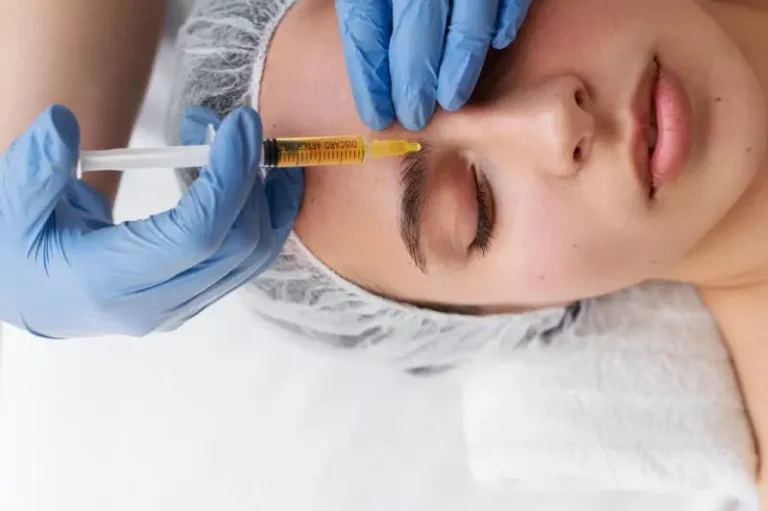
Few aesthetic treatments have created an image quite as memorable as the Vampire Facial.
When Kim Kardashian appeared with her face covered in blood during a PRP treatment in 2013, the treatment quickly became one of the most talked-about beauty procedures of the decade. More than ten years later, PRP is still part of the conversation around skin quality, microneedling and regenerative aesthetics. Kim Kardashian helped popularise the treatment, and more recently Hailey Bieber has publicly discussed using PRP alongside microneedling.
But behind the celebrity photos is a real treatment called Platelet-Rich Plasma therapy, or PRP.
PRP uses a concentrated portion of your own blood and can be used alongside microneedling or administered using injections, depending on the treatment being performed.
So what does PRP actually do, what does the research say, and why are people still searching for Vampire Facials in Birmingham?
At Hello Skin Clinic Birmingham, PRP facial treatment begins with a consultation so your skin concerns, treatment goals and suitability can be considered before proceeding.
PRP stands for Platelet-Rich Plasma.
Your blood naturally contains plasma and platelets. Platelets play an important role in clotting and contain proteins and growth factors involved in normal tissue repair.
During a PRP treatment, a small amount of your blood is collected and processed using a centrifuge. This separates different components of the blood and allows a platelet-rich portion to be prepared for treatment.
For facial treatments, PRP may then be used alongside microneedling, administered through injections, or incorporated into a treatment protocol depending on the practitioner, treatment area and individual goals.
Because the PRP comes from your own blood, it is known as an autologous treatment.
That does not mean PRP is risk-free. Needling, blood collection and injections can still cause side effects and require appropriate infection-control procedures.
The nickname is much more dramatic than the treatment itself.
PRP became known as the Vampire Facial because your own blood is collected, processed and then used as part of the facial treatment.
The name became famous after Kim Kardashian underwent the procedure on television in 2013 and shared photographs of her blood-covered face.
The dramatic appearance made excellent television, but PRP itself is the platelet-rich component separated from the client’s blood.
The terms are also sometimes used inconsistently.
A PRP facial may involve PRP combined with microneedling, while PRP can also be administered using injections. Your practitioner should explain exactly which technique is being proposed before treatment.
One reason PRP continues to attract interest is that it uses material obtained from the client’s own blood rather than adding a traditional dermal filler product.
Clients often explore PRP when their goals involve improving the appearance of:
However, the scientific evidence varies depending on the concern being treated and whether PRP is used alone or alongside treatments such as microneedling.
A systematic review of PRP for facial rejuvenation found encouraging findings but also highlighted substantial variation in treatment methods and the overall quality of available evidence. More recent reviews have similarly concluded that PRP is promising, while noting that certainty around some aesthetic outcomes remains limited.
So PRP should not be marketed as a guaranteed route to flawless or younger-looking skin.
Microneedling and PRP are frequently used together.
Microneedling uses very fine needles to create controlled microchannels in the skin. PRP can then be incorporated into the treatment according to the practitioner’s protocol.
This combination has been particularly studied in relation to acne scarring.
A meta-analysis comparing microneedling with PRP against microneedling alone found better outcomes for acne scar improvement and patient satisfaction in the combined-treatment groups.
That does not mean every acne scar should be treated using PRP.
Different types and depths of acne scarring may require very different treatment strategies, so a skin assessment should come before choosing a procedure.
Depending on the individual, PRP facial treatment may be discussed when concerns include:
Clients concerned about rough or uneven-looking texture may explore PRP as part of a skin treatment plan.
Some research into facial rejuvenation has reported improvements in wrinkle appearance, although results vary and the quality of evidence is not uniform.
PRP has been studied particularly when combined with procedures such as microneedling or laser treatment for acne scars. Research suggests the combination may provide additional benefit for some patients compared with microneedling alone.
People also explore PRP when their overall goal is fresher or healthier-looking skin, although individual response varies.
PRP is sometimes incorporated into broader skin-quality treatment plans rather than being used to dramatically alter facial shape or volume.
This is an important distinction.
Fillers are generally used when the goal involves:
PRP is generally considered when the focus is more on:
PRP does not work like a traditional hyaluronic acid dermal filler.
If your main concern is volume loss or facial structure, PRP may not be the treatment that best matches your goal.
At Hello Skin Clinic Birmingham, your journey should begin with a consultation.
Your practitioner discusses your concerns, relevant history, previous treatments and what you would like to improve.
This is also the opportunity to discuss whether PRP is suitable for you.
A small amount of blood is taken, similar to a routine blood draw.
The blood is placed into a centrifuge, which separates its components so the platelet-rich portion can be prepared.
Depending on your treatment plan, PRP may be used alongside microneedling, administered using injections, or used according to another practitioner-led protocol.
Your practitioner explains what to expect following the procedure and provides appropriate aftercare guidance.
The exact appointment process can vary according to the treatment technique and individual circumstances.
PRP facial treatments involve blood collection and either microneedling, injections or both, so some discomfort is possible.
Individual sensitivity varies considerably.
The face also contains areas that may feel more sensitive than others.
If pain or discomfort is something you are concerned about, discuss it during your consultation so your practitioner can explain what to expect and what measures may be used during your appointment.
Recovery depends partly on how the PRP is delivered.
Following microneedling or injections, temporary effects may include:
Clinical studies of facial PRP have reported effects such as redness, swelling and bruising following treatment.
Your practitioner should tell you what is considered an expected response and when you should contact the clinic.
Avoid planning an unfamiliar injectable or microneedling treatment immediately before an important event.
PRP should not be described as completely risk-free simply because it uses your own blood.
Using autologous material avoids exposure to donor plasma, but the procedure still involves:
Appropriate hygiene and infection-control standards are therefore extremely important.
This is not theoretical. Poor infection-control practices during PRP-style cosmetic procedures have previously been associated with transmission of blood-borne infection at an unlicensed facility in the United States.
That unusual but serious example demonstrates why you should choose a professional setting where appropriate protocols for blood handling, sterile equipment and single-use items are followed.
PRP suitability cannot be determined from a blog article.
Your practitioner needs to consider factors such as:
Always provide accurate information during consultation.
Do not stop prescribed medication simply because you are preparing for an aesthetic treatment unless the healthcare professional responsible for that medication advises you to do so.
There is no universal number.
You may see clinics advertising fixed courses of three treatments or predetermined maintenance schedules, but the appropriate approach depends on:
Your practitioner should explain the recommended plan and why it has been suggested.
PRP is not generally considered an instant transformation treatment.
Changes reported in studies of facial rejuvenation have typically been assessed over a period of weeks or months rather than immediately after one appointment.
Any change you experience will depend on factors including your skin, concern, age, treatment protocol and individual response.
A temporary post-treatment flush should also not be confused with a lasting result.
This is one area where the evidence is particularly interesting.
Studies have investigated PRP:
Research reviews suggest PRP may improve outcomes when added to certain acne-scar procedures, but study methods and quality vary.
There is also evidence showing that PRP alone may not perform as well as other resurfacing treatments for some types of acne scarring.
This is why identifying the type of scar is more useful than simply asking:
“Is PRP good for acne scars?”
PRP and polynucleotides are both discussed within modern skin-quality treatments, but they are very different.
PRP is prepared from your own blood and contains a concentrated platelet-rich component.
Polynucleotide treatments use manufactured products containing purified DNA-derived polymers, commonly obtained from salmonid fish.
Both treatments may be discussed when the goal is improving skin quality, but they use different materials and treatment protocols.
There is no universal winner.
Your skin concern and suitability should determine which options are worth considering.
PRP is also different from injectable skin boosters.
Many skin boosters use hyaluronic acid formulations and focus particularly on hydration and skin quality.
PRP comes from your own blood.
Someone primarily concerned about dehydration may therefore be offered a very different treatment plan from someone concerned about acne scarring or uneven texture.
This is another reason why consultation matters more than following whichever treatment is currently trending online.
Kim Kardashian’s 2013 Vampire Facial helped turn PRP into a global beauty talking point.
The trend did not disappear with that television episode.
PRP continues to feature in celebrity skincare conversations. In 2025, Hailey Bieber discussed liking PRP combined with microneedling as part of her own beauty routine.
But celebrity use should be viewed as cultural context, not evidence that a treatment will work for you.
The decision should come down to:
What is your concern?
What does the available evidence suggest?
Are you suitable?
What result are you realistically trying to achieve?
Those questions matter much more than who has posted the treatment on Instagram.
You should not have to know exactly which skin treatment to book before speaking to us.
At Hello Skin Clinic Birmingham, PRP facial treatment begins with consultation and assessment.
We start by understanding your concern rather than immediately recommending a procedure.
PRP may be discussed as a standalone option or within a broader skin plan depending on your goals and suitability.
We want clients to understand what a treatment may help with, what recovery can involve and where evidence remains limited.
PRP facial treatment is provided by trained practitioners using treatment-specific procedures.
Hello Skin Clinic is located at 21 Sheepcote Street, King Edwards Wharf, Birmingham B16 8AB. The clinic’s current PRP service page confirms that PRP facial treatment is offered from its Birmingham location.
A Vampire Facial is a popular name for a cosmetic treatment involving platelet-rich plasma prepared from your own blood, commonly combined with microneedling.
PRP is the platelet-rich plasma used during the procedure. “Vampire Facial” is an informal name commonly used when PRP is combined with a facial skin treatment such as microneedling.
Yes. Kim Kardashian underwent a Vampire Facial on Kourtney and Kim Take Miami in 2013, helping bring widespread attention to the treatment.
Research suggests that adding PRP to microneedling may improve outcomes for some acne scars compared with microneedling alone. That does not mean PRP is suitable for every type of scar.
PRP is prepared from your own blood, but describing the entire procedure simply as “completely natural” can be misleading. It still involves blood processing, needles and a clinical procedure.
Because PRP is autologous, it is prepared from the client’s own blood rather than donor material. However, this does not make the procedure risk-free. Injection, microneedling, infection and other procedure-related risks still need to be considered.
Redness, swelling, bruising, tenderness or dryness can occur after facial PRP treatment. Recovery varies depending on the technique used and individual response.
There is no single schedule that is appropriate for everybody. Your practitioner should recommend a treatment plan based on your concern, treatment method and response.
They are not necessarily competing treatments. PRP is frequently combined with microneedling. Research into acne scarring suggests the combination may provide additional benefit for some clients compared with microneedling alone.
The celebrity photos made PRP famous.
The more important question today is whether the treatment makes sense for your skin.
Research into PRP for facial rejuvenation is encouraging in some areas, particularly when PRP is used alongside other procedures, but the scientific evidence is not equally strong for every cosmetic claim. Reviews continue to call for better-quality and more standardised research.
That is why we would not promise flawless skin, guaranteed collagen production or a dramatic transformation.
PRP is one option within a much wider range of skin treatments.
For the right person and the right concern, it may be worth discussing.
For somebody else, HydrO2, microneedling, SQT, polynucleotides, skin boosters, chemical peels or another treatment route may make more sense.
If you are interested in PRP for concerns such as uneven texture, certain acne scars, fine lines or general skin quality, start with a consultation.
At Hello Skin Clinic Birmingham, we can assess your concerns, explain the PRP treatment process and discuss whether it is an appropriate option for you.
Explore our PRP Treatment (Vampire Facial) in Birmingham
PRP treatment is subject to consultation and individual suitability. Potential benefits, side effects, downtime and results vary between individuals.