



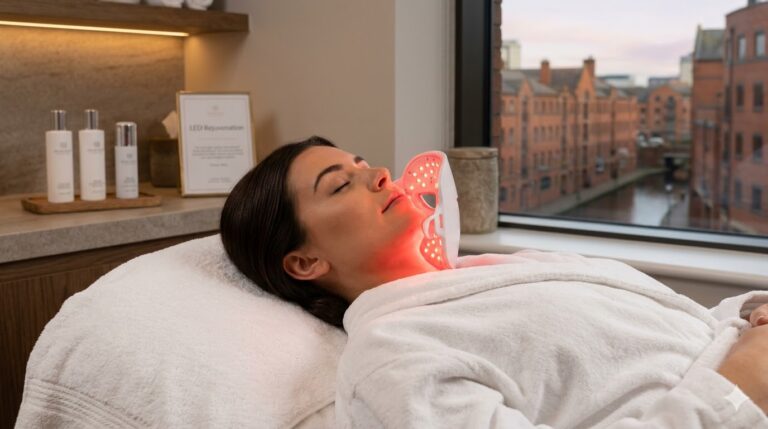
You have probably seen the photos.
A celebrity lying beneath a glowing red LED mask, looking as though their skincare routine has suddenly become part beauty treatment and part science fiction.
Kourtney Kardashian was photographed using LED light therapy years ago, and red light devices have since become a familiar part of celebrity skincare routines and beauty content. More recently, red light masks, panels and handheld devices have become far more accessible outside celebrity treatment rooms.
But behind the glowing masks is a genuine technology called LED light therapy, also known in some contexts as photobiomodulation.
Red and near-infrared wavelengths are being studied for their effects on skin appearance, while blue LED light has also been investigated for inflammatory acne.
At Hello Skin Clinic Birmingham, LED Light Therapy can be used as a standalone skin treatment or incorporated into a wider treatment plan depending on your skin concerns and suitability.
So what actually happens beneath those red lights, and is LED therapy worth adding to your skincare routine?
LED stands for Light Emitting Diode.
LED skin treatments use specific wavelengths of visible or near-infrared light directed towards the skin.
Unlike ultraviolet light, the wavelengths used in red light therapy are non-ionising and do not work by deliberately damaging or removing the surface of the skin.
Red light therapy is commonly described as a form of photobiomodulation.
Research suggests that particular wavelengths of light can interact with biological processes within cells, although the exact mechanisms and the strength of evidence vary depending on the condition being treated.
This makes LED very different from treatments such as:
There are no needles and no controlled removal of the surface layer of skin.
That is one reason LED is often incorporated into skin routines where clients want a lower-downtime treatment.
Red light and near-infrared light have attracted particular attention in skin rejuvenation research.
Studies have investigated their potential effects on:
A 2023 clinical study examining red-light photobiomodulation reported improvements in several visible signs associated with skin ageing. Other research has also explored changes in collagen-related activity following red and near-infrared light exposure.
However, LED should not be marketed as an instant facelift or a guaranteed way to produce new collagen.
Results depend on factors including:
Consistency and correct treatment parameters matter more than simply sitting beneath any red light.
You may sometimes hear red light therapy described as giving your skin cells “more energy”.
That is a simplified explanation.
Current research into photobiomodulation suggests that red and near-infrared light may influence cellular processes, including mitochondrial activity and signalling involved in tissue repair and inflammation.
Mitochondria are structures inside cells involved in producing energy.
Photobiomodulation research suggests that certain wavelengths may influence mitochondrial function and downstream cellular activity, although scientists are still investigating exactly how these effects translate into different clinical outcomes.
For a client, the more useful explanation is this:
LED uses specific wavelengths of light rather than heat, needles or exfoliating acids to influence biological activity within the skin.
There is research suggesting red and near-infrared light may influence collagen production and improve some visible signs of skin ageing.
For example, clinical studies have reported improvements in wrinkle measurements and skin appearance following photobiomodulation protocols. Laboratory and clinical research has also investigated red light’s effect on fibroblasts, the cells involved in producing components such as collagen.
But it is important not to turn that into:
“One LED session will dramatically rebuild your collagen.”
That would be unrealistic.
LED is generally better viewed as a gradual treatment that may support skin-quality goals over time.
Red is not the only wavelength used in LED skin treatments.
Blue light has been studied particularly in relation to inflammatory acne.
One of the reasons is its interaction with Cutibacterium acnes, a bacterium associated with acne.
Laboratory research has demonstrated antimicrobial effects of blue light against C. acnes, and clinical studies have investigated blue LED treatment for mild to moderate inflammatory acne.
Some LED devices combine:
Blue light for acne-related bacterial activity
with:
Red light for its potential effects on inflammation and skin recovery.
Clinical studies using combinations of blue and red LED wavelengths have reported improvement in inflammatory acne.
No.
That is an important distinction.
Acne is a complex inflammatory skin condition.
Factors can include:
LED may form part of an acne treatment plan for some people, particularly for inflammatory acne, but it should not be described as a universal cure.
If you have persistent, painful, cystic or scarring acne, appropriate medical assessment may be more important than simply booking an LED facial.
The easiest way to understand LED colours is that different wavelengths interact with the skin differently.
Commonly explored for:
Commonly explored for:
May be considered when inflammatory breakouts are present and both acne-related bacterial activity and inflammation are treatment considerations.
The appropriate wavelength should depend on what your skin actually needs.
More colours do not automatically mean a better treatment.
No.
The words laser and LED are sometimes casually grouped together because both involve light, but they are very different technologies.
Laser devices generally produce highly focused light and can be used for treatments including:
LED uses lower-energy, non-coherent light across a treatment area.
Professional photobiomodulation is generally considered non-thermal, meaning the goal is not to heat and destroy tissue.
This is one reason LED typically has far less downtime than resurfacing procedures.
Part of the answer is simple.
It looks incredible on camera.
The glowing red mask has become one of the most recognisable images in modern beauty technology.
Kourtney Kardashian publicly shared an LED treatment image as far back as 2016, and celebrity use helped make glowing masks a familiar part of skincare culture. Vogue has also documented the rapid growth of red light therapy across beauty, wellness and professional facial settings.
But celebrity use should not be confused with scientific proof.
A Kardashian using an LED mask does not mean:
The more useful question is whether professional LED therapy is appropriate for your particular skin concern.
Depending on the wavelength, device and individual assessment, LED therapy may be considered for concerns including:
Clients looking for a low-downtime addition to their skin routine may explore red LED as part of a broader skin-quality plan.
Photobiomodulation research has investigated red and near-infrared wavelengths for wrinkle appearance and other signs associated with photoageing.
Blue light, sometimes combined with red light, has been investigated for mild to moderate inflammatory acne.
LED is sometimes incorporated alongside other aesthetic treatments as part of a practitioner-led recovery or skin-care protocol.
Whether that is appropriate depends on the treatment you have received and the LED device being used.
LED does not exfoliate the skin in the same way as acids or resurfacing procedures, which can make it attractive to clients looking for a gentler treatment experience.
However, gentle does not mean suitable for absolutely everyone.
Some medicines, medical conditions and light sensitivities may affect suitability.
Your practitioner should know if you:
Suitability should still be assessed before treatment.
Professional LED therapy is usually a comfortable treatment.
There are:
You typically lie beneath or close to an LED device while the selected wavelength is delivered for a set period.
Some devices may feel mildly warm, although photobiomodulation itself is intended to be non-thermal when correctly delivered.
The exact experience depends on the equipment and treatment protocol.
One of the attractions of LED Light Therapy is that it generally does not involve the type of visible recovery associated with treatments such as deeper chemical peels or microneedling.
That can make it useful for clients who want something they can fit more easily around work or social plans.
However, response always depends on the individual and the specific device.
Your practitioner should explain what to expect before treatment.
Be cautious of promises such as:
“One session will transform your skin.”
Photobiomodulation research generally involves repeated treatments rather than expecting dramatic long-term change from one exposure.
The American Academy of Dermatology also notes that when red light therapy is used for skin concerns, results can vary and more research is still needed to understand which devices and protocols work best.
If LED forms part of your skin plan, think of it as something that may support gradual improvement rather than an instant transformation.
At-home LED masks have become extremely popular.
They can be convenient, but an expensive glowing mask is not automatically equivalent to professional equipment.
The effectiveness of an LED treatment depends on technical factors such as:
The American Academy of Dermatology notes that professional red light treatments offered by dermatologists can use more powerful devices than many products designed for home use.
This is another reason why it is difficult to judge an LED product purely by how bright it looks.
This is one of the most practical ways LED can fit into a skin programme.
Depending on the facial and your skin, your practitioner may recommend LED as:
At Hello Skin Clinic, the decision should come down to what makes sense for your skin rather than automatically adding every available technology to one appointment.
More treatment is not always better treatment.
These treatments work very differently.
Someone concerned primarily about established acne scarring may therefore receive a very different recommendation from someone concerned about mild inflammatory breakouts.
Again, these are not interchangeable.
Chemical peels use acids to create controlled exfoliation.
They may be considered when concerns include:
LED does not exfoliate the skin.
In some treatment plans, the two may have completely different roles.
Your experience begins with understanding your skin.
We discuss your concerns, current skincare, relevant history and what you would like to improve.
Your practitioner considers whether LED is appropriate and which treatment approach may be relevant.
Your skin is prepared according to the treatment protocol.
You relax beneath the professional LED device while the selected light wavelength is delivered.
Protective measures are used according to the equipment and manufacturer’s protocol.
Your practitioner explains any relevant skincare or treatment advice following the session.
LED has become fashionable, but we do not believe treatment should be recommended simply because it is trending.
At Hello Skin Clinic Birmingham, our approach is based on understanding what you want to improve first.
Your skin concerns come before the device.
LED may be recommended as a standalone treatment or incorporated into another skin plan where appropriate.
We explain what LED may support without promising unrealistic transformations.
Your treatment takes place at our Birmingham clinic using practitioner-led protocols.
If LED is not the best match for your concern, we can discuss other appropriate skin treatment routes rather than forcing one treatment to fit everyone.
Red light therapy uses specific red or near-infrared wavelengths as a form of photobiomodulation. Research has investigated its potential effects on skin ageing, tissue repair and other concerns.
Research suggests certain red and near-infrared wavelengths can influence collagen-related processes and may improve signs such as fine lines and wrinkles. Results depend on the device and treatment protocol.
Blue LED light has antimicrobial activity against Cutibacterium acnes and has been studied for mild to moderate inflammatory acne.
No. LED may form part of an acne treatment plan, but acne is a complex condition and not every type of acne will respond in the same way.
LED therapy is non-invasive and generally does not involve needles or deliberate damage to the skin surface.
No. LED and laser technologies deliver light differently and are used for different treatment purposes.
There is no universal number. The appropriate schedule depends on the device, concern and treatment plan.
Sometimes. LED may be incorporated into another suitable facial or skin programme depending on your skin and the treatments involved.
Professional and home devices can differ substantially in wavelength, power and energy delivered. Device specifications and correct dosing matter more than appearance alone.
The glowing celebrity photos made LED famous.
But the technology deserves to be judged on more than Instagram.
There is genuine scientific interest in photobiomodulation for skin ageing and other dermatological applications, with studies reporting promising results for some concerns. At the same time, the evidence is not equally strong for every claim, every wavelength or every device.
That means LED is neither magic nor meaningless.
It is a treatment tool.
For the right person and the right concern, it may be a useful part of a skin plan.
For somebody else, a different treatment may be more appropriate.
If you are interested in LED for skin rejuvenation, fine-line appearance, inflammatory breakouts or simply want to understand whether it fits into your current skin plan, start with a conversation.
At Hello Skin Clinic Birmingham, we can assess your concerns and explain whether LED Light Therapy is an appropriate option for you.
Learn more about our LED Light Therapy in Birmingham.
Book Your Skin Consultation
Hello Skin Clinic
21 Sheepcote Street, King Edwards Wharf
Birmingham B16 8AB
LED Light Therapy is subject to consultation and individual suitability. Potential benefits and results vary depending on the individual, treatment protocol and device.